Rwandan Genocide.
“I was deep in prayer when the killers came to
search the house a second time.”
“During that second search, the killers’ racket reached the edge of my prayers like an angry voice waking me from a dream. Then I heard four or five loud bangs next to my head, and they had my full attention. I realized that they were right there in the pastor’s bedroom! They were rummaging through his belongings, ripping things from the wall, lifting up the bed, and overturning chairs.”
“During that second search, the killers’ racket reached the edge of my prayers like an angry voice waking me from a dream. Then I heard four or five loud bangs next to my head, and they had my full attention. I realized that they were right there in the pastor’s bedroom! They were rummaging through his belongings, ripping things from the wall, lifting up the bed, and overturning chairs.”
“I covered my mouth with my hands, fearing that
they’d hear me breathing. They were only inches from my head . . . the floor
was creaking in front of the wardrobe—the wardrobe! I thanked God
again for it, but my heart still thumped against my chest.”
Can you imagine being this close to death?
The italicized paragraphs above are an excerpt from Imaculee
Ilibagiza’s book ‘Left to tell’. One
of the most compelling books I’ve ever come across. ‘Left to tell’ tells a young woman’s view of the Rwandan genocide.
Hotel Rwanda is a Hollywood re-construction of a hotel
manager’s perspective on the genocice. Paul Rusesabagina had been the manager
of the Hôtel des Diplomates. He saved about 1268 people from sure death during
the genocide. A true hero in my opinion.
Both stories have one thing in common, horror!
The sheer horror and spate of destruction meted out on the
Tutsis of Rwanda is almost unprecedented in the history of the planet. About
20% of the country’s population was wiped out within two to three months. That
is the same as saying at the end of about three months; one in every five human
beings in the country was dead. Just because they were Tutsis.
A good question to ask is ‘how did all these come about’?
For centuries there had been under boiling tensions between
the Tutsi minority and the Hutu majority. The Tutsis had held control for
centuries through a monarchy and the Hutus had come to power in a rebellion in
1962 and had overthrown the monarchy.
The resulting government was led by Grégoire Kayibanda.
Kayibanda was then overthrown by his own minister for defence, Major Juvénal
Habyarimana. Habyarimana held on to power for a long time. Longest time frame
in the history of Rwandan presidents as a matter of fact. His government leaned
towards favouring the Hutu majority. His government was obviously not as
extreme as most Hutu extremists would expect. Also seeing as he was not
entirely favouring the Tutsis, he was caught in no-man’s land. His plane was shot down on the evening of 6
April 1994. Obviously the blame was shifted from camp to camp but seeing as the
majority of the government was run by Hutus, the Tutsis had to go. They had
always wanted it anyway and now here was an excuse.
Théodore
Sindikubwabo was installed as the head of government. British
intelligence report that Sindikubwabo and Hutu hardliners organized
Habyarimana's assassination due to concerns over the Arusha Accords (which
would have given Tutsis more say in the government). The Sindikubwabo administration came to
power and under the control of Colonel Théoneste Bagosora carried out probably
the greatest massacre in our time!
 |
| How did the world let this happen? How?! |
The media
was highly utilized to propagate propaganda to the Rwandan populace. Especially
the radio (due to the high level of illiteracy). The Hutu majority of the
country was turned overnight into one big, angry, violent, blood-thirsty set of
demons. And the Hutus that refused to be turned were treated like the Tutsis
they refused to kill. They were butchered! And mercilessly so too!
It was
sheer horror. Dead bodies littered the streets. There was no hiding place for
the helpless souls who had been left to fend for themselves. Even churches were
not spared. Orphanages were rampaged. I remember Imaculee saying his brother’s
head was split open because the Hutu militia guys wanted to see what his brain
looked like seeing he had a master’s degree! I also saw a girl’s story of
living in a pile of dead people for about 43 days! Horror cannot even describe
what it was like.
But in all
these, what flips me out the most is the reaction of the international
community. Shameful will be a ridiculous understatement. Ridiculous would be
flattering to the absolutely shocking response of the major players in the
international community. They simply watched people get slaughtered. There can be
an argument that they did not know what was going on but there’s no way I’m
buying that. If they did not know what was going on, why did they all pull
their citizens and expatriates out of the country? If they were not sure what
was going on, why did they shut their embassies? If they were not aware what
was going on, why did they keep shutting down the African voices in the UN
assembly? They knew what was happening, they just chose to do nothing. The
truth is, a little while earlier, the US had been faced with a similar
situation in Somalia and it had not gone well and they did not want a repeat in
Rwanda. So rather than approach the situation differently, they chose to do
nothing.
I really am
not making that up, they chose to do absolutely nothing and watch the slaughter
of hundreds of thousands of innocent lives!
However, as
is any story, where there are villains, there are also heroes. The UN commander
in Rwanda at the time was a man named Romeo Dallaire. Some hero he was. He
defied the orders to pull out all his soldiers and stayed in the country.
Obviously he wasn’t able so save all the lives, but he saved as many as
possible. There was Henry Anyidoho, his Ghanaian deputy. When all or at least
most of the other countries pulled out their troops from the United Nations
mission, Anyidoho kept his Ghanaian troops. Phillipe Gillard of the Red Cross
also stayed in the country. He was backed by the Red Cross international
community. And what a job he did. There was a moment he was said to have
physically stood up to Colonel Bagosora. If that doesn’t say ‘BRAVE’ I’m not
sure what does. Carl Wilkens was also the only American remaining in the country.
He didn’t have to stay, but he did. Paul Rusesebagina whose heroics are
documented in the Hollywood flick ‘Hotel Rwanda’ was also worth his weight in
gold. These are heroes. But I don’t think any hero holds a candle to Captain
Mbaye Diagne. He held no gun. He used no force. He confronted the killers
harmed with nothing but his charm and smile. He saved many lives driving and
ferrying Tutsis to safety. And unfortunately he paid the ultimate price. I ask
myself, if Diagne was a Canadian or a British soldier, how much mention and
coverage would he get?
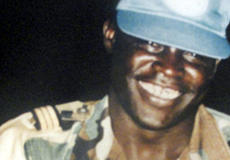 |
| Mbaye Diagne: True hero |
The
genocide is gone and somehow the country has survived. Fortunately with a Tutsi
currently in power. Justice is still being sought in some quarters I can
imagine but can there really be justice for such a wide scale of destruction of
human lives and souls?


